Tyto alba: The Acoustic Ghost of Twilight
Acoustic morphology and mythic archetype of the world's most widespread raptor
What is a barn owl?
The barn owl (Tyto alba) is a pale, heart-faced owl found on every continent except Antarctica. It hunts at night by sound, and the soft edges of its flight feathers let it fly almost silently.
Silent, heart-faced, and possessing sensory capabilities that border on the surreal, the Barn Owl (Tyto alba) is an evolutionary triumph of predatory physics. Operating in the absolute penumbra where human sight fails, this cosmopolitan raptor maps the nocturnal landscape through hyper-accurate auditory triangulation.
Historical Context & Origins
Fossil evidence places Tytonidae owls in the Miocene epoch, demonstrating over twenty million years of anatomical refinement. Revered and feared in equal measure, traditional rural communities welcomed them into timber barns and church belfries as peerless natural rodent control, while superstitious folklore often cast their eerie, raspy shrieks and pale silhouettes as omens of otherworldliness.
Symbolism, Myth, & Iconography
Unlike the classical horned owl associated with Athena's analytical wisdom, the heart-faced Tyto alba occupies an esoteric symbolic realm. In Celtic mythology, owls are guardians of the Underworld and psychopomps guiding souls through shadows. In modern semiotics, the barn owl represents unblinking discernment—the capacity to observe what remains concealed from ordinary awareness.
Morphology & Aesthetic Evaluation
The owl's heart-shaped facial ruff functions as a dual biological parabolic radar dish, funneling minute sound waves directly into vertically offset ear apertures. Furthermore, the leading barbs of its primary flight feathers feature tiny comb-like serrations (flutings) that disrupt shearing air vortices into micro-currents, silencing the wingbeat entirely.
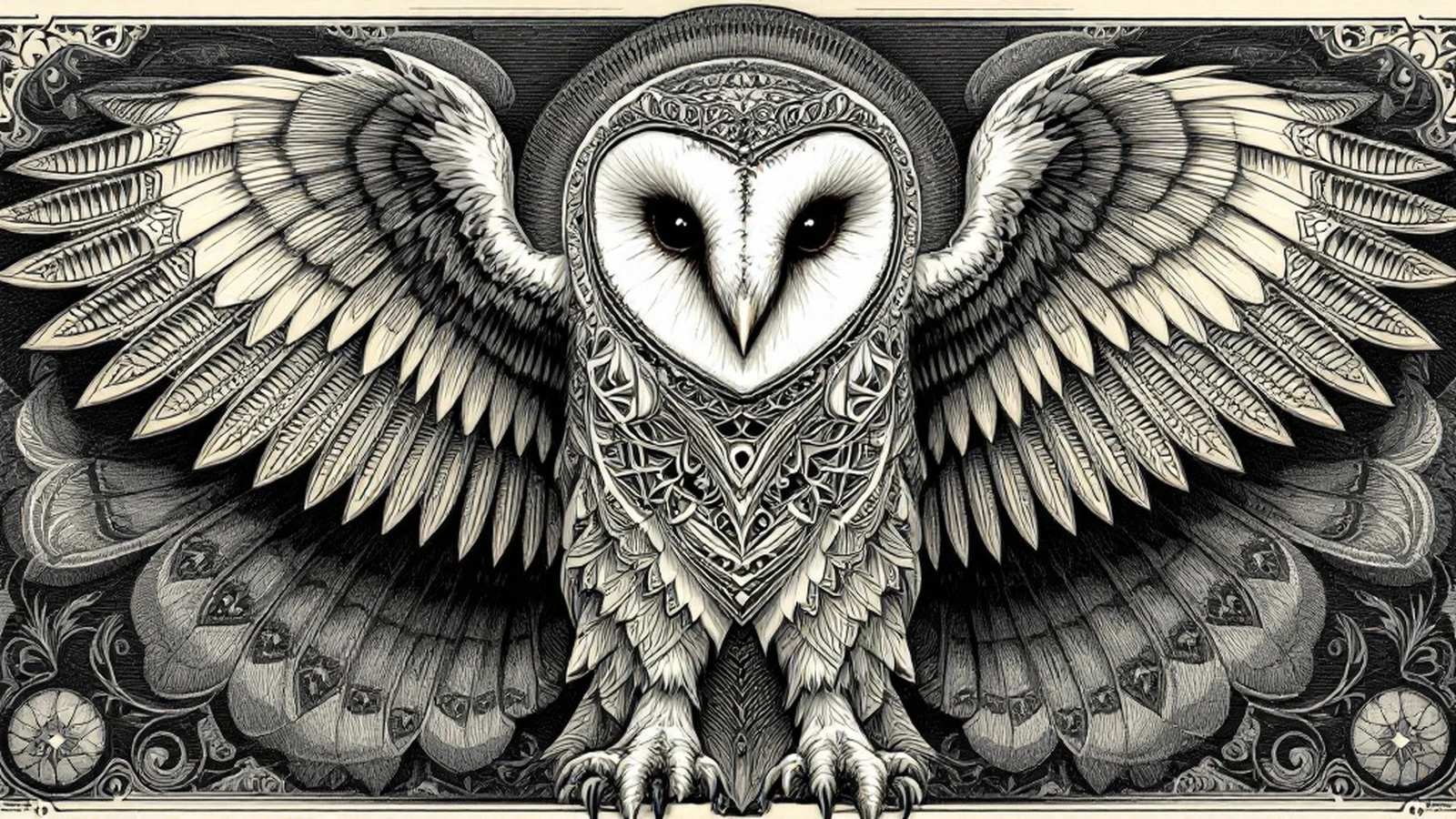
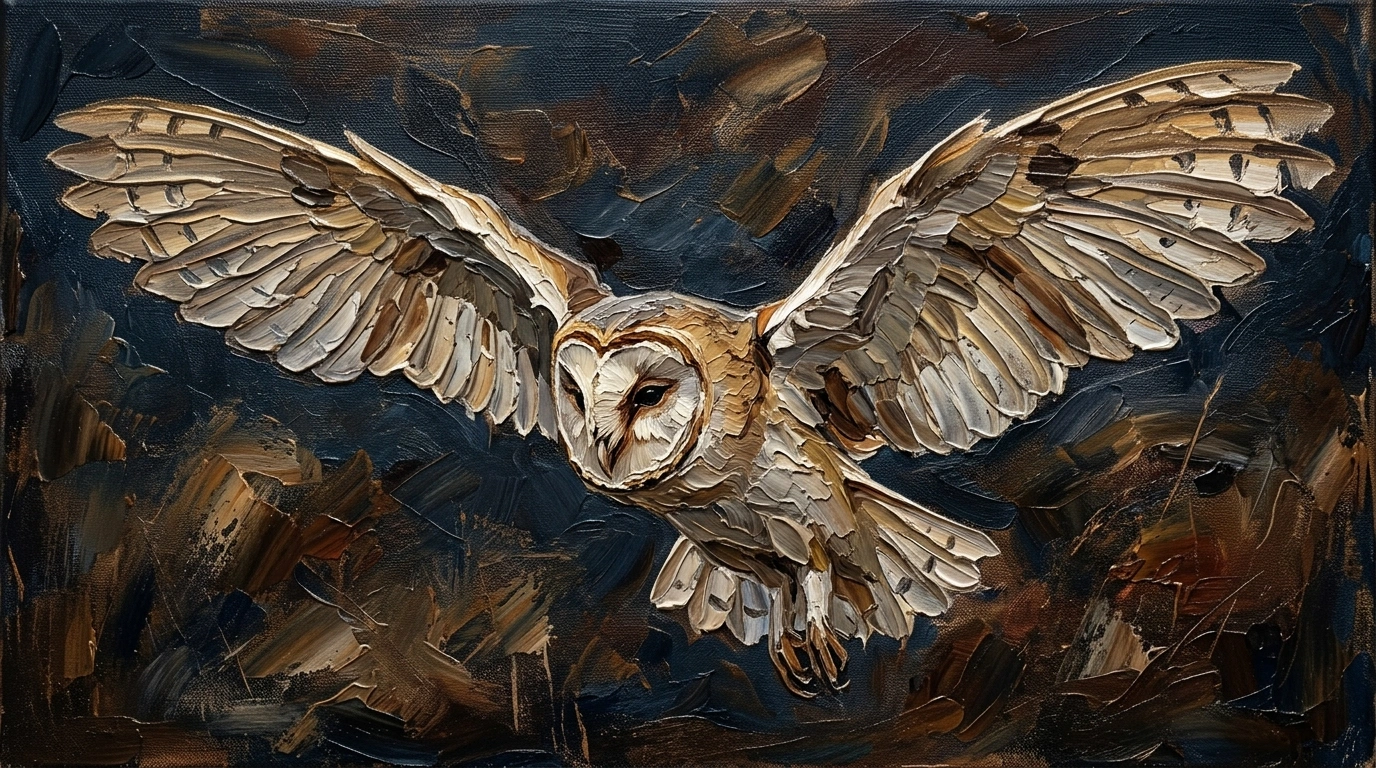
In the Cladeset gallery, the barn owl's acoustic geometry lends itself to Guilloché Engraving, where interlocking mathematical curves recreate the quiet density of its plumage, and its pale face and dark eyes read strongly in ochre impasto.
Bibliographic Citations & Reference Material:
- •Taylor, I. (1994). Barn Owls: Predator-Prey Relationships and Conservation. Cambridge University Press.
- •Knudsen, E. I. (1981). The hearing of the barn owl. Scientific American, 245(6), 112-125.