Nishikigoi: The Living Canvases of Japanese Culture
A taxonomic and cultural monograph on ornamental Cyprinus rubrofuscus
What is a koi?
Koi, or nishikigoi ("brocaded carp"), are ornamental carp (Cyprinus rubrofuscus) bred in Japan since the early 19th century for colour and pattern. They are valued as living art and symbolise perseverance.
Far more than ornamental pond fish, Nishikigoi (literally 'brocaded carp') represent one of history's most disciplined long-term biological art forms. Developed from common black river carp (Magoi) in the snow-locked mountain villages of Niigata, Japan, koi transform natural genetics into swimming masterpieces of scale, form, and pigment.
Historical Context & Origins
In the early 19th century, farmers in the mountainous Ojiya and Yamakoshi districts of Niigata Prefecture kept carp in holding ponds above terraced rice paddies to supplement winter protein. When natural genetic mutations produced red and white markings, breeders isolated these specimens not for consumption, but to appreciate their dynamic beauty through crystal snowmelt. By the 1914 Taisho Exhibition in Tokyo, Nishikigoi were exhibited nationally, establishing their cultural standing as living artworks.
Symbolism, Myth, & Iconography
Central to the iconography of Nishikigoi is the ancient legend of the Longmen ('Dragon Gate') cataract on the Yellow River. According to mythology, thousands of carp swam upstream against treacherous currents, but only those possessing extraordinary resolve surmounted the roaring waterfall. Upon reaching the summit, the heavens transformed the carp into a celestial dragon. Consequently, koi embody perseverance (Nintai), courage, ambition, and triumphant metamorphosis.
Morphology & Aesthetic Evaluation
Judges and collectors evaluate Nishikigoi across three core criteria established by Japanese standards: Body Conformation (Taikei), Skin Quality and Luster (Hada and Teri), and Pattern Balance (Moyo). The fish must possess a robust, spindle-shaped volume tapering symmetrically toward the tail tube (ozutsu) without pinched fins. Crucially, the clarity and sharpness of the trailing edge of pattern plates against the snow-white skin ground (shiroji) is known as kiwa. Japanese masters distinguish between kamisori-kiwa—a crisp, razor-straight boundary cutting cleanly across scale plates—and maruzome-kiwa, which gracefully follows the scalloped outer contour of individual scales. In contrast, the leading forward edge of a pattern plate where pigment dips beneath the scales is termed sashi.
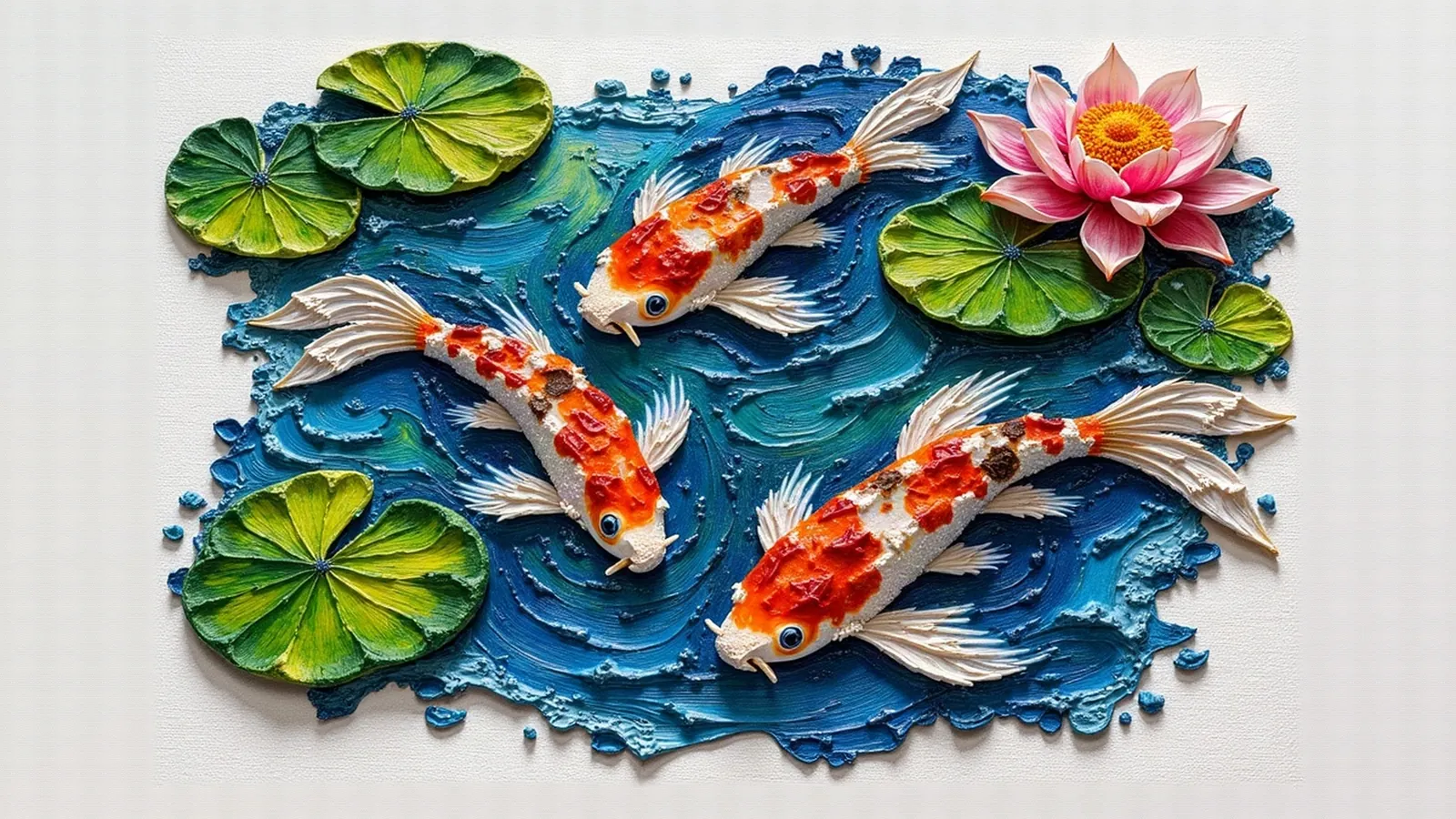
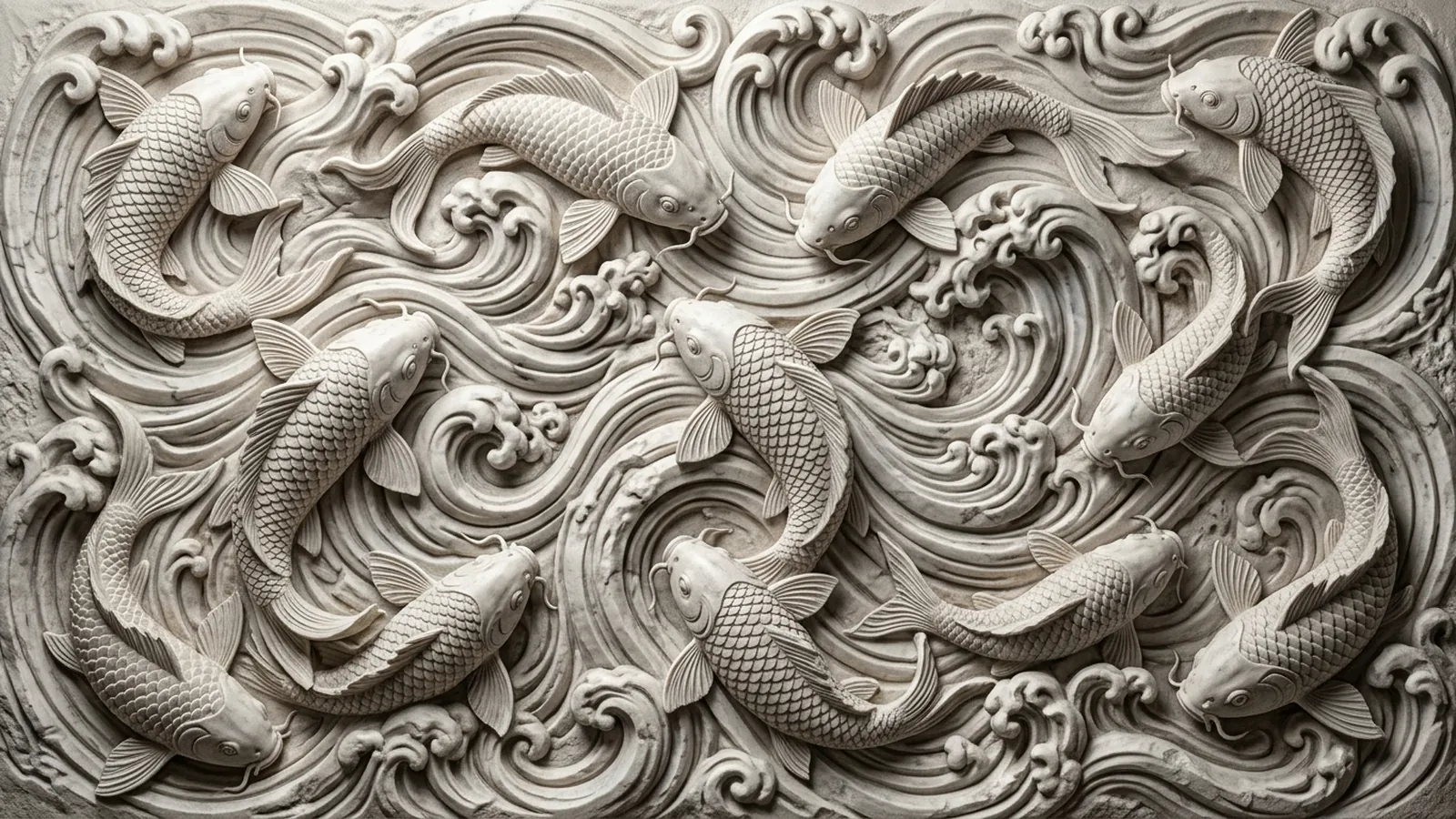
At Cladeset, the koi's undulating rhythm is reinterpreted across diverse mediums: the glossy three-dimensional peaks of oil impasto preserve its kinetic power, while carved plaster studies its pure fluid volume in raking light.
Bibliographic Citations & Reference Material:
- •Kuroki, T. (1981). The Latest Manual to Nishikigoi. Shin Nippon Kyoiku Tosho, Tokyo.
- •Tamadachi, M. (1994). Cult of the Koi (2nd ed.). T.F.H. Publications, Neptune City, NJ.