Fiber Art: Wool as Architecture
From the Bauhaus loom to the monumental wall hanging
What is fiber art?
Fiber art uses wool, flax and other threads as a sculptural material, moving weaving from the home to the gallery wall. Anni Albers's On Weaving (1965) and MoMA's 1969 Wall Hangings exhibition helped shape the field.
Fiber art treats wool, flax and other threads as a sculptural material, and moves weaving out of the home and onto the gallery wall.
Historical Context & Origins
Anni Albers, trained at the Bauhaus weaving workshop, argued in On Weaving (1965) that textile is a structural art, not a decorative one. In the 1960s Magdalena Abakanowicz in Poland and Lenore Tawney in the United States made woven works that hung free in space. The 1969 exhibition Wall Hangings at the Museum of Modern Art in New York, organised by Mildred Constantine and Jack Lenor Larsen, brought the movement to a wide audience, and their book Beyond Craft: The Art Fabric followed in 1973.
Symbolism, Myth, & Iconography
Textile carries associations of warmth, touch and domestic labour. In fiber art these are kept and made large: the fibre is shown as an object with weight and direction, not as cloth.
Morphology & Aesthetic Evaluation
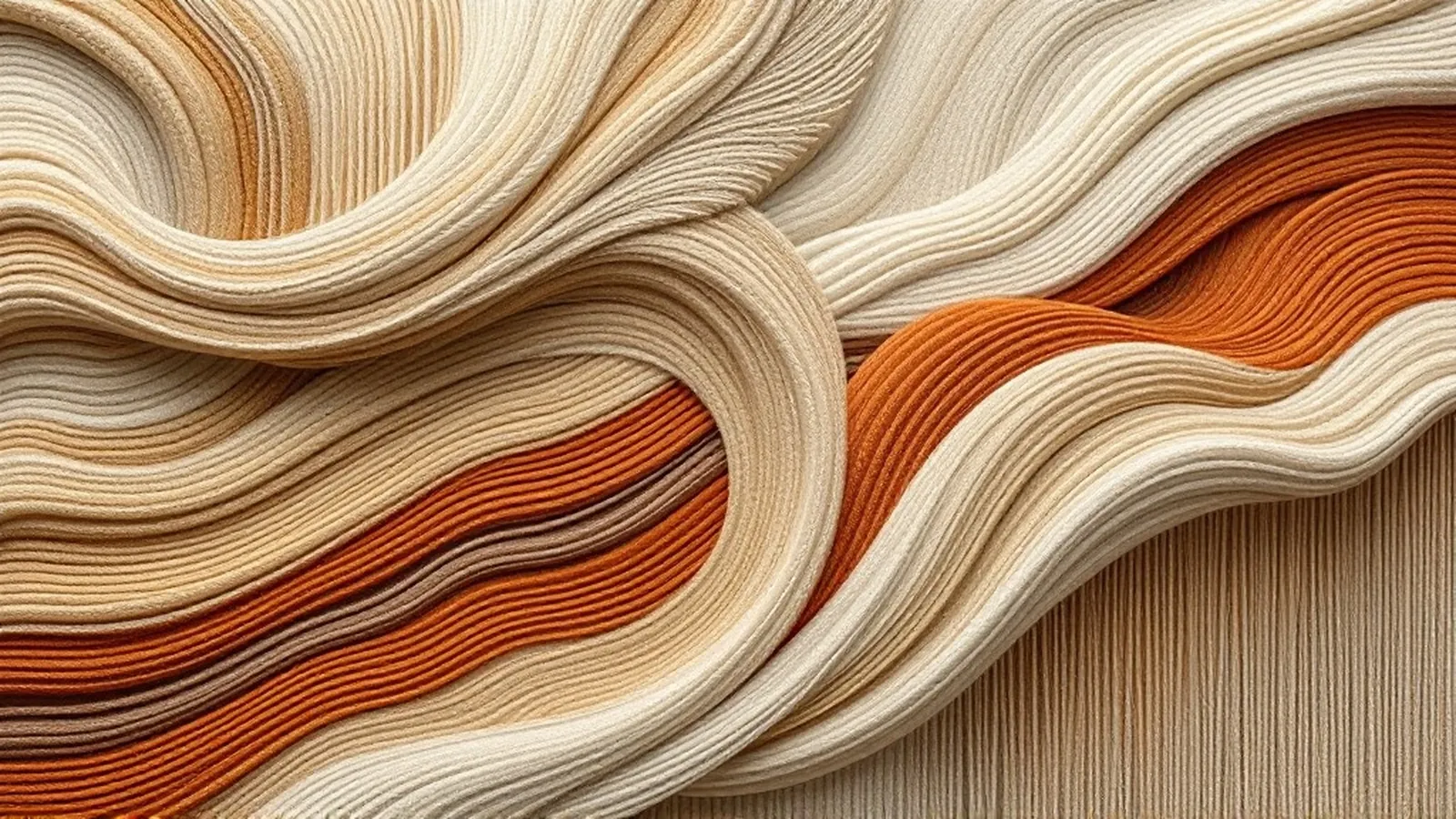
Weft is the thread carried across the warp. In sculptural weaving, roving, which is loosely twisted wool, is built up in flowing runs that follow a line across the surface. Under directional light, each strand casts its own shadow and the overall field reads as a set of currents.
Cladeset's Sinuous Weft and Roving Currents follows that tradition: directional lines of fibre that read as architectural line and shadow, without decorative clutter.
Bibliographic Citations & Reference Material:
- •Albers, A. (1965). On Weaving. Wesleyan University Press, Middletown.
- •Constantine, M., & Larsen, J. L. (1973). Beyond Craft: The Art Fabric. Van Nostrand Reinhold, New York.