Le Tricolore: Three Bands, One Revolution
The cockade, the decree of 1794, and the template for national flags
What is the French tricolour?
Le Tricolore is the flag of France: three vertical bands of blue, white and red. It grew from the cockades of the 1789 Revolution, and the National Convention fixed its arrangement by decree in 1794.
The French tricolour is a design of three equal vertical bands. Its simplicity, and the political weight it carried from 1789, made it the model for many later national flags.
Historical Context & Origins
In July 1789 the Parisian militia wore cockades in the city's colours, blue and red. White, the colour of the Bourbon monarchy, was added, and the combined cockade became the symbol of the Revolution. The National Convention fixed the flag's arrangement by decree on 15 February 1794, with blue at the hoist, white in the middle and red at the fly. After a period of Restoration white, the tricolour returned in 1830 and has been the flag ever since.
Symbolism, Myth, & Iconography
The colours are often read as liberty, equality and fraternity, but that reading came later than the flag. Its lasting meaning is the claim that sovereignty belongs to the nation and not to a dynasty. Michel Pastoureau's history of colour notes how long blue, once a minor colour, took to become a major one in European heraldry and dress.
Morphology & Aesthetic Evaluation
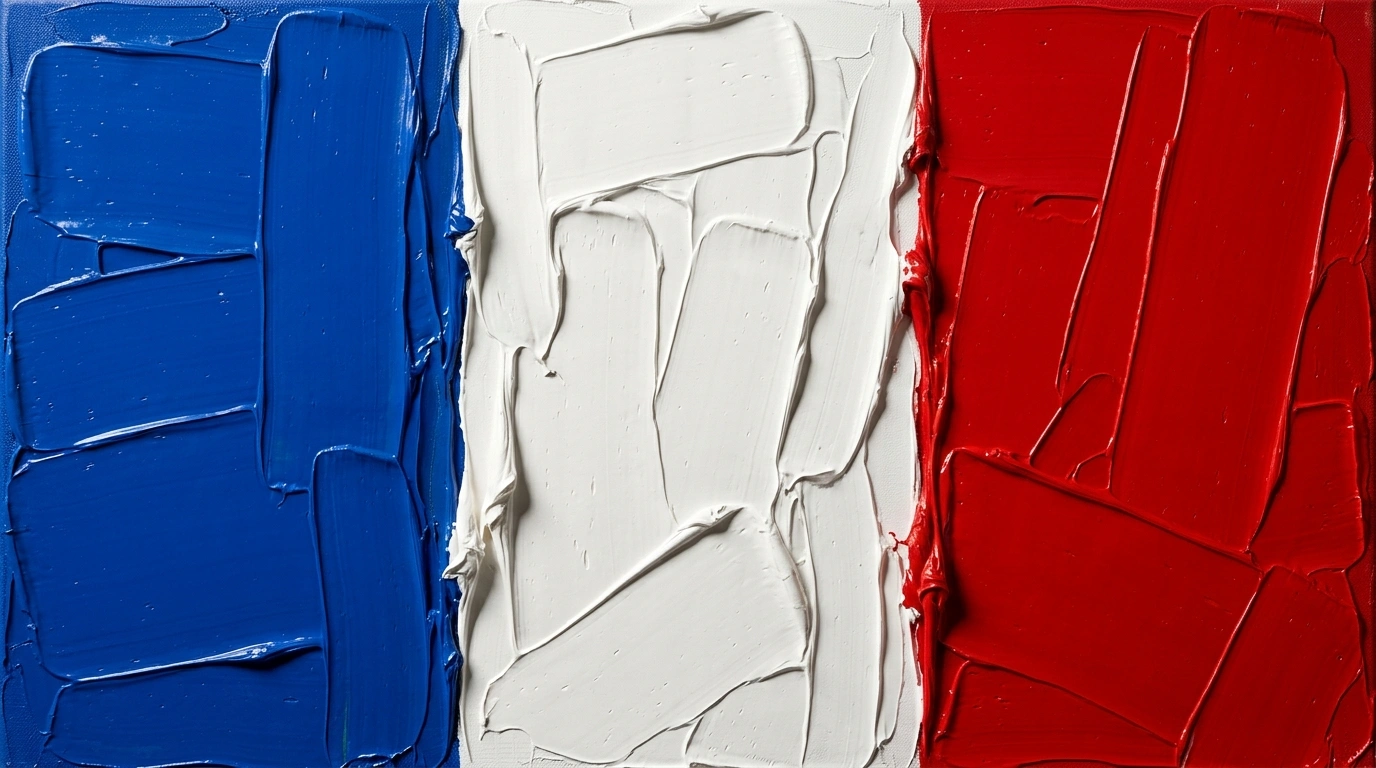
Equal vertical bands, no emblem, three flat colours: the flag is pure colour-field. In paint, the places where the bands meet matter most, because the edges of blue, white and red must stay distinct without bleeding into one another.
In heavy impasto oil, the three bands collide in thick paint, and the seams between them become low ridges where the wet colours meet and push against each other.
Bibliographic Citations & Reference Material:
- •Pastoureau, M. (2001). Blue: The History of a Color. Princeton University Press.
- •Smith, W. (1975). Flags Through the Ages and Across the World. McGraw-Hill, New York.