Nisshoki: The Sun-Mark Flag
A red disc on white, and the economy of Japanese graphic form
What is the flag of Japan?
The flag of Japan, Nisshoki or Hinomaru, is a red disc on a white field. It was prescribed for Japanese merchant ships in 1870 and fixed in law as the national flag in 1999.
The flag of Japan is a white field with a single red disc, centred. Its formal name is Nisshoki, the sun-mark flag, and in everyday speech it is called Hinomaru, the circle of the sun.
Historical Context & Origins
The sun disc appears on Japanese fans and banners for centuries before it became a national flag. It was prescribed for Japanese merchant ships in 1870, and served as the national flag in practice from then on. It was fixed in law only in 1999, by the Act on the National Flag and Anthem, which set the proportions at 2 to 3 with a disc whose diameter is three fifths of the flag's height, centred.
Symbolism, Myth, & Iconography
The sun is central to Japan's founding myths, where the imperial line descends from the sun goddess Amaterasu, and Japan's name, Nihon or Nippon, means the origin of the sun. The disc has also been used for military and nationalist purposes, which still shapes how the flag is discussed within Japan and abroad.
Morphology & Aesthetic Evaluation
The flag is one shape and one colour on a ground. Its graphic economy made it an influence on twentieth-century Japanese design, where a single circular form on an empty field is a recurring compositional device.
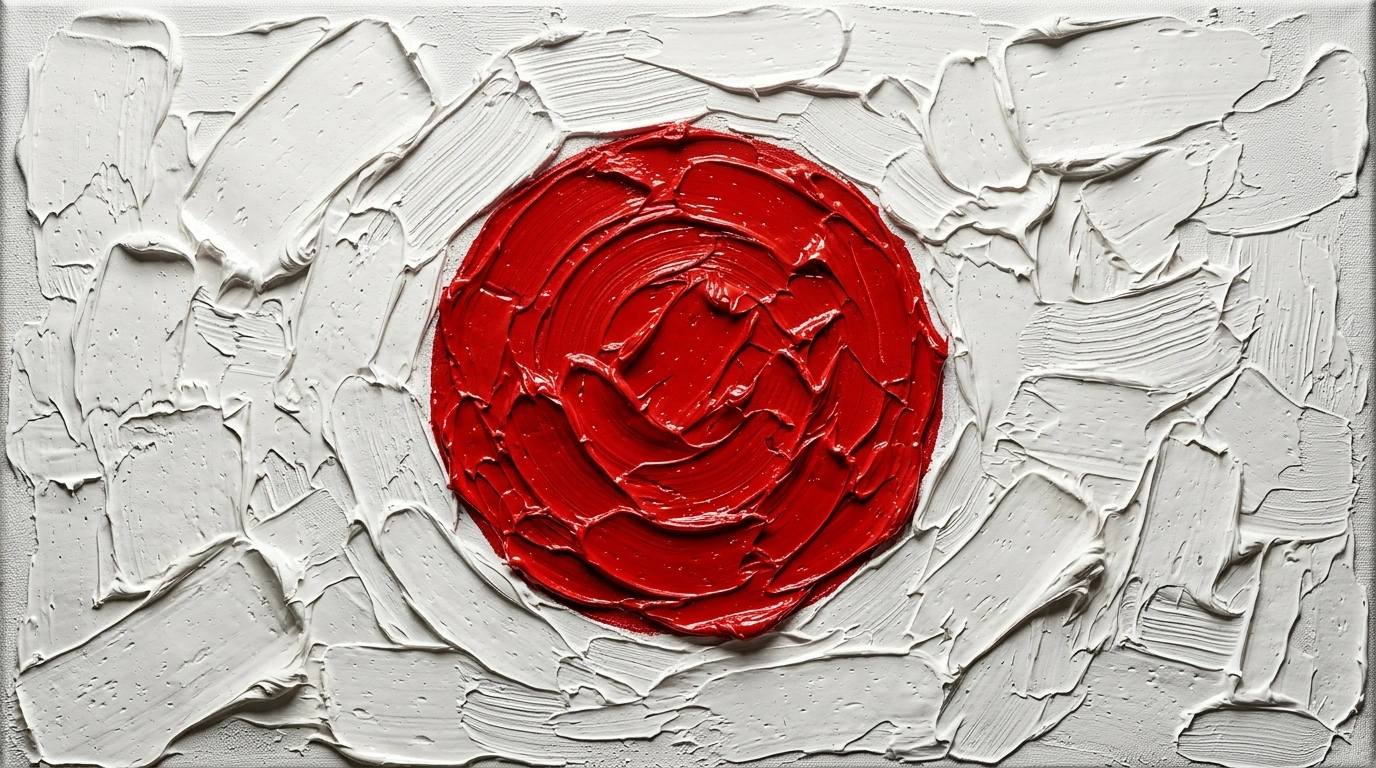
Cladeset paints the disc in heavy impasto, so the single red form is a raised, tactile mass set against slabs of white paint.
Bibliographic Citations & Reference Material:
- •Smith, W. (1975). Flags Through the Ages and Across the World. McGraw-Hill, New York.