The Stars and Stripes: A Flag Built to Change
From the 1777 resolution to the fifty-star flag, and a century of painters
What is the flag of the United States?
The Stars and Stripes has thirteen red and white stripes for the original colonies and fifty white stars on a blue field for the states. Adopted in 1777 and redrawn as the country grew, the fifty-star design dates from 1960.
The flag of the United States is unusual among national flags because its design was meant to change. Every new state adds a star, and the flag has been redrawn many times since 1777.
Historical Context & Origins
On 14 June 1777 the Continental Congress resolved that the flag of the United States be thirteen stripes, alternate red and white, with thirteen white stars in a blue field. The flag that flew over Fort McHenry in 1814, and inspired Francis Scott Key's poem, had fifteen stars and fifteen stripes. The Flag Act of 1818 returned to thirteen stripes and added a star for each new state. The present fifty-star arrangement took effect on 4 July 1960, after Hawaii's admission.
Symbolism, Myth, & Iconography
The 1777 resolution gave no meanings for the colours. The best-known explanation comes from Charles Thomson, who in 1782 described the colours of the Great Seal: white for purity, red for valour, blue for vigilance and justice. The flag is also, in American painting, a subject in its own right. Jasper Johns began his Flag series in 1954, painting it in encaustic, and made the flag itself the object of the painting, not an emblem within it.
Morphology & Aesthetic Evaluation
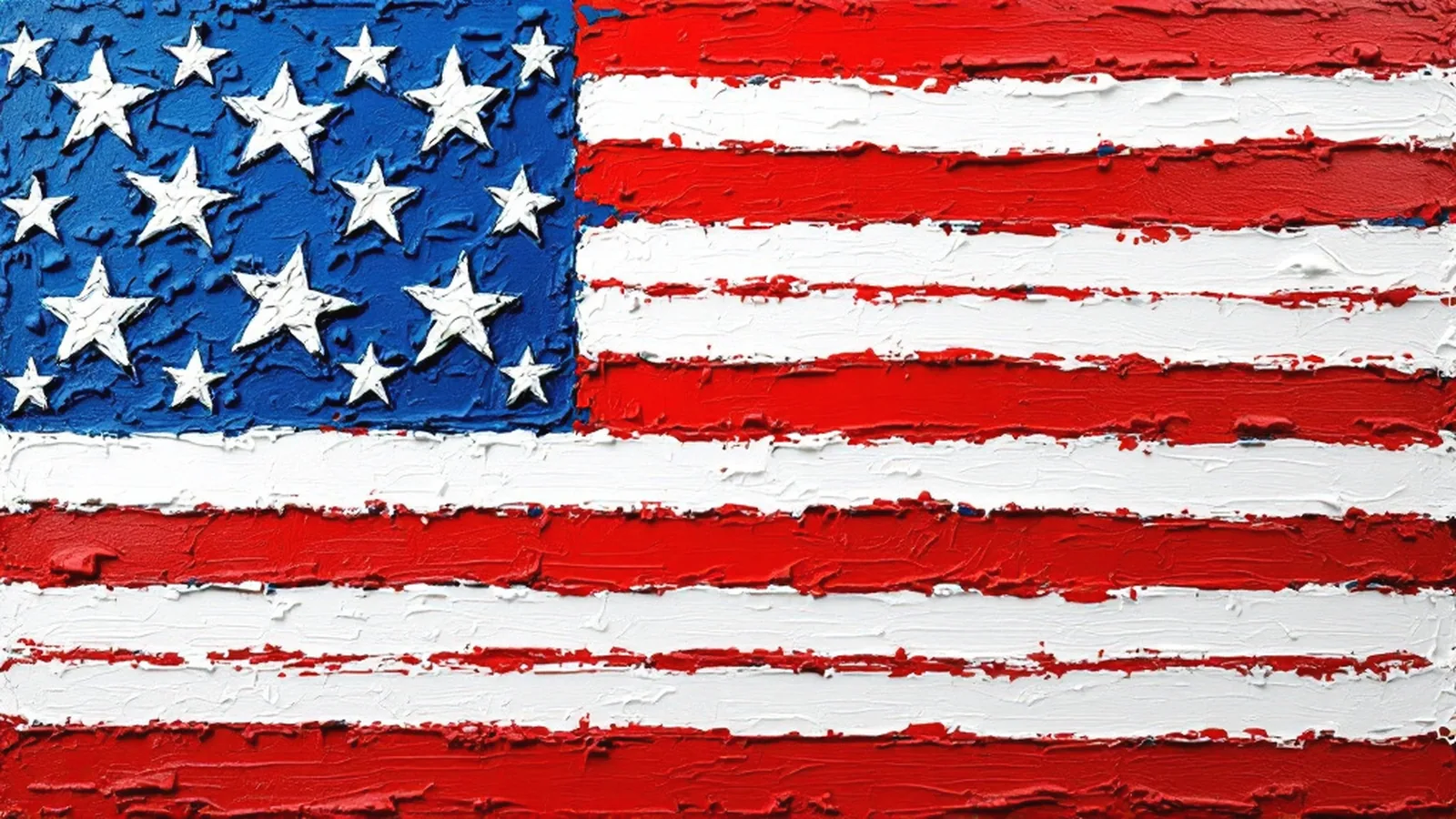
The flag has a fixed proportion of 10 to 19, a union of fifty stars set in nine offset rows, and seven red and six white stripes. The offset star rows and the strongly horizontal stripes give it a rhythm that reads clearly even in heavy paint.
Cladeset's flags are painted in heavy impasto oil: thick, palette-knife paint that stands off the surface, so the stripes and stars carry the tactile surface that Johns found in wax.
Bibliographic Citations & Reference Material:
- •Leepson, M. (2005). Flag: An American Biography. Thomas Dunne Books, New York.
- •Smith, W. (1975). Flags Through the Ages and Across the World. McGraw-Hill, New York.