Origami Tessellations: Folded Pattern as Structure
Repeating crease patterns, one uncut sheet, and the geometry of deployable surfaces
What is an origami tessellation?
An origami tessellation is a fold pattern repeated across a single uncut sheet of paper, so the surface becomes a relief of peaks and valleys. Artists such as Shuzo Fujimoto and Ron Resch developed it from the 1960s.
An origami tessellation is a pattern of folds repeated across a single sheet of paper, so that the surface itself becomes a relief of peaks and valleys. It sits between art, mathematics and engineering.
Historical Context & Origins
The form developed in the second half of the twentieth century. Shuzo Fujimoto in Japan and Ron Resch in the United States explored folded surfaces from the 1960s, and Eric Gjerde's 2008 book brought tessellation folding to a wide audience. Koryo Miura's Miura-ori fold, studied in the 1970s and 1980s, was developed for packaging large membranes, such as solar panels, to deploy in space from a small package.
Symbolism, Myth, & Iconography
There is no inherited iconography. The meaning is mathematical: order, repetition and the way a flat plane can be given volume by folding alone. Robert Lang's work shows how crease patterns can now be designed computationally.
Morphology & Aesthetic Evaluation
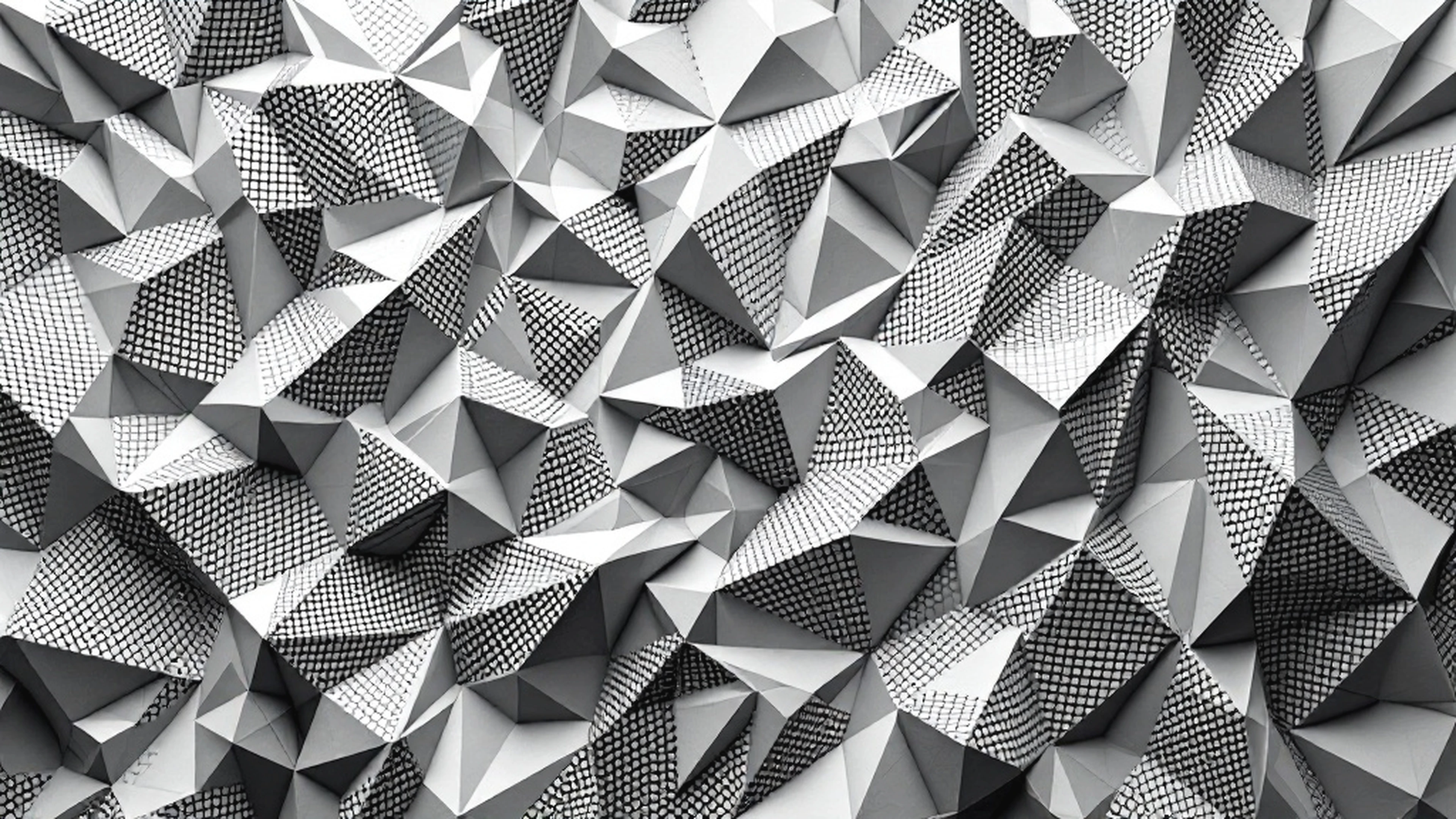
A tessellation is built from repeated units such as the square twist or the triangle, folded along mountain and valley creases. Raking light reveals each facet as a different tone, so the pattern reads strongly in directional light and changes as the light moves.
Cladeset presents the tessellation in folded paper at close range, where the faceting and the fine paper grain are visible, and light and shadow do the work of colour.
Bibliographic Citations & Reference Material:
- •Gjerde, E. (2008). Origami Tessellations: Awe-Inspiring Geometric Designs. A K Peters, Wellesley.
- •Lang, R. J. (2003). Origami Design Secrets: Mathematical Methods for an Ancient Art. A K Peters, Natick.
- •Miura, K. (1985). Method of packaging and deployment of large membranes in space. Institute of Space and Astronautical Science Report, Tokyo.