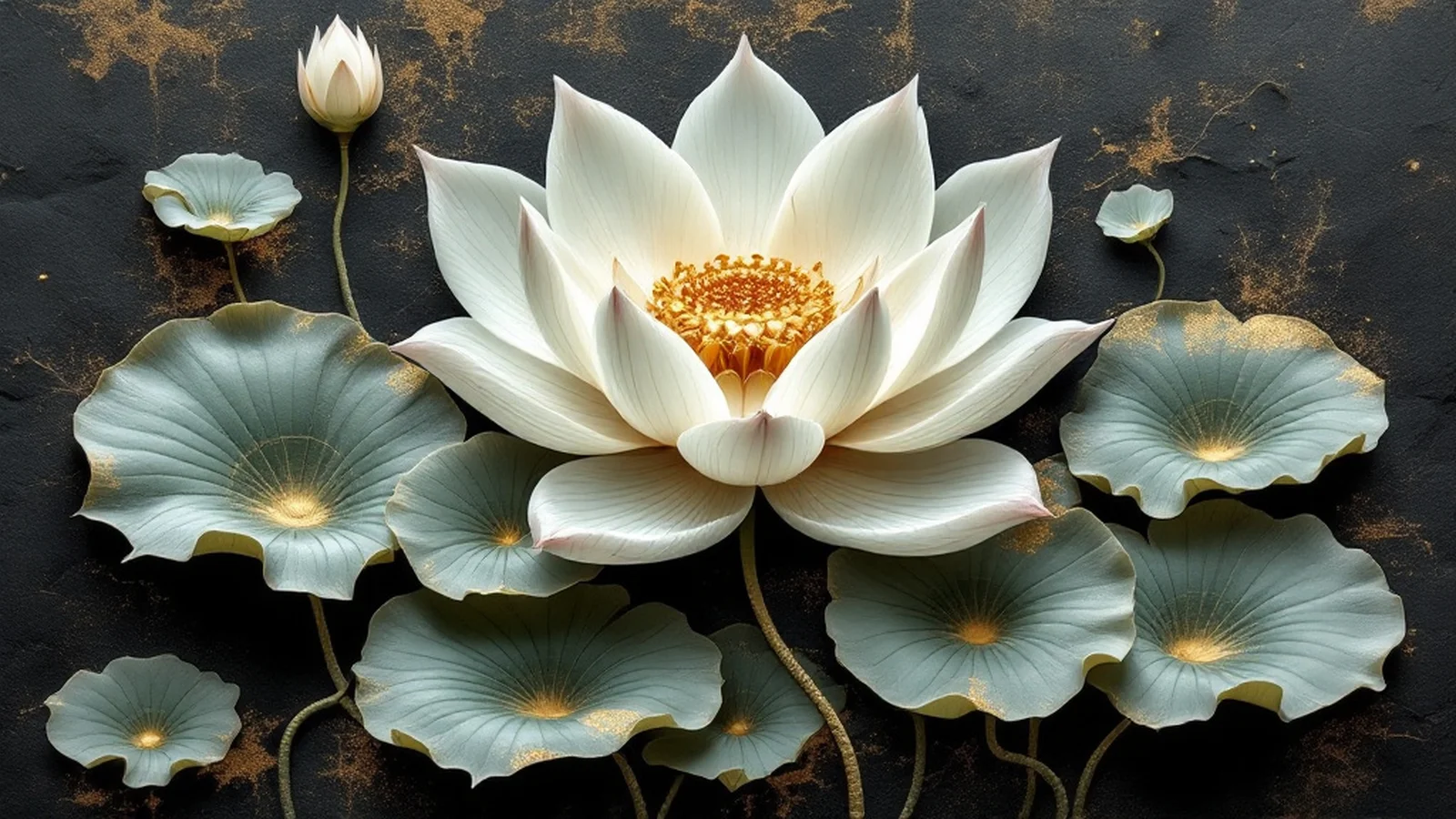
Nelumbo nucifera: The Flower That Rises Clean
Botany, symbolism and the self-cleaning leaf of the sacred lotus
What is the sacred lotus?
The sacred lotus (Nelumbo nucifera) is an aquatic plant of Asia whose leaves and flowers rise clean above muddy water. In Buddhism and Hinduism it symbolises awakening and purity, and its leaf repels water and dirt.
The sacred lotus roots in mud and holds its leaves and flowers above the water, apparently untouched by the silt it grows from. That image, more than the flower's beauty, is why it became one of the most reused symbols in Asian art.
Historical Context & Origins
Nelumbo nucifera has been cultivated across Asia for several thousand years, for food, medicine and ritual. Its rhizomes, seeds and leaves are all eaten. Lotus seeds are famously long-lived: fruits recovered from a dry lake bed in China have been germinated after centuries, with radiocarbon ages of roughly a thousand years. The lotus of ancient Egyptian art is a different plant, the blue water lily Nymphaea caerulea, and the two are often confused.
Symbolism, Myth, & Iconography
In Buddhism the lotus stands for awakening: a mind that grows through the world without being stained by it. Buddhas and bodhisattvas are shown seated or standing on lotus thrones. In Hindu tradition Brahma emerges from a lotus growing from Vishnu's navel, and Lakshmi is shown seated on one. In East Asian art the same flower marks summer, integrity and the scholar who keeps his principles in a corrupt court.
Morphology & Aesthetic Evaluation
The leaf is the scientifically notable part. Its upper surface is covered in microscopic papillae coated with wax crystals, so water beads into spheres and rolls off, carrying dirt with it. Barthlott and Neinhuis described this in 1997 and named it the lotus effect; it is the model for many self-cleaning coatings. The flower is built in layers: a ring of broad outer petals, narrower inner ones, a ring of stamens and a flat seed receptacle shaped like a showerhead at the centre.
Cladeset shows the lotus as a carved object, in nephrite jade and raw gold, so the layered petals read as sculpture: translucent stone for the petals, hammered metal for the stamens and the receptacle.
Bibliographic Citations & Reference Material:
- •Barthlott, W., & Neinhuis, C. (1997). Purity of the sacred lotus, or escape from contamination in biological surfaces. Planta, 202(1), 1-8.
- •Shen-Miller, J., et al. (2002). Long-living lotus: germination and soil gamma-irradiation of centuries-old fruits, and cultivation, growth, and phenotypic abnormalities of offspring. American Journal of Botany, 89(2), 236-247.