Monstera deliciosa: The Leaf With Windows
How a Central American climber became the emblem of the modern interior
What is Monstera deliciosa?
Monstera deliciosa, the Swiss cheese plant, is a climbing plant from the rainforests of southern Mexico and Central America, known for large leaves with holes and slits. It became a staple of modern interiors.
The monstera's deeply cut, perforated leaf is among the most recognisable plant forms in modern design. It is also an unusual piece of botany: a climbing aroid whose leaves develop holes as they mature.
Historical Context & Origins
Monstera deliciosa is native to the rainforests of southern Mexico and Central America and was brought to European glasshouses in the nineteenth century. It became a fixture of twentieth-century interiors, and the mid-century modern period in particular made its silhouette a decorative shorthand for the tropics indoors. Michael Madison's 1977 revision of the genus at Harvard's Gray Herbarium remains the standard taxonomic reference.
Symbolism, Myth, & Iconography
Unlike the lotus or the koi, the monstera carries no inherited mythology. Its meaning is modern: abundance, domestic nature, and the biophilic idea that living green belongs inside buildings. The name deliciosa refers to the fruit, which is edible when fully ripe and unpleasant when not, because the unripe flesh contains needle-like calcium oxalate crystals.
Morphology & Aesthetic Evaluation
Young leaves are whole and heart-shaped. As the plant climbs toward light, new leaves grow larger and develop fenestrations, holes that begin as gaps in the folded leaf and widen into the slits along the margin. Why the holes form is still discussed; proposed functions include letting light reach lower leaves and reducing wind damage, and none is settled. Aerial roots anchor the stem to the host tree.
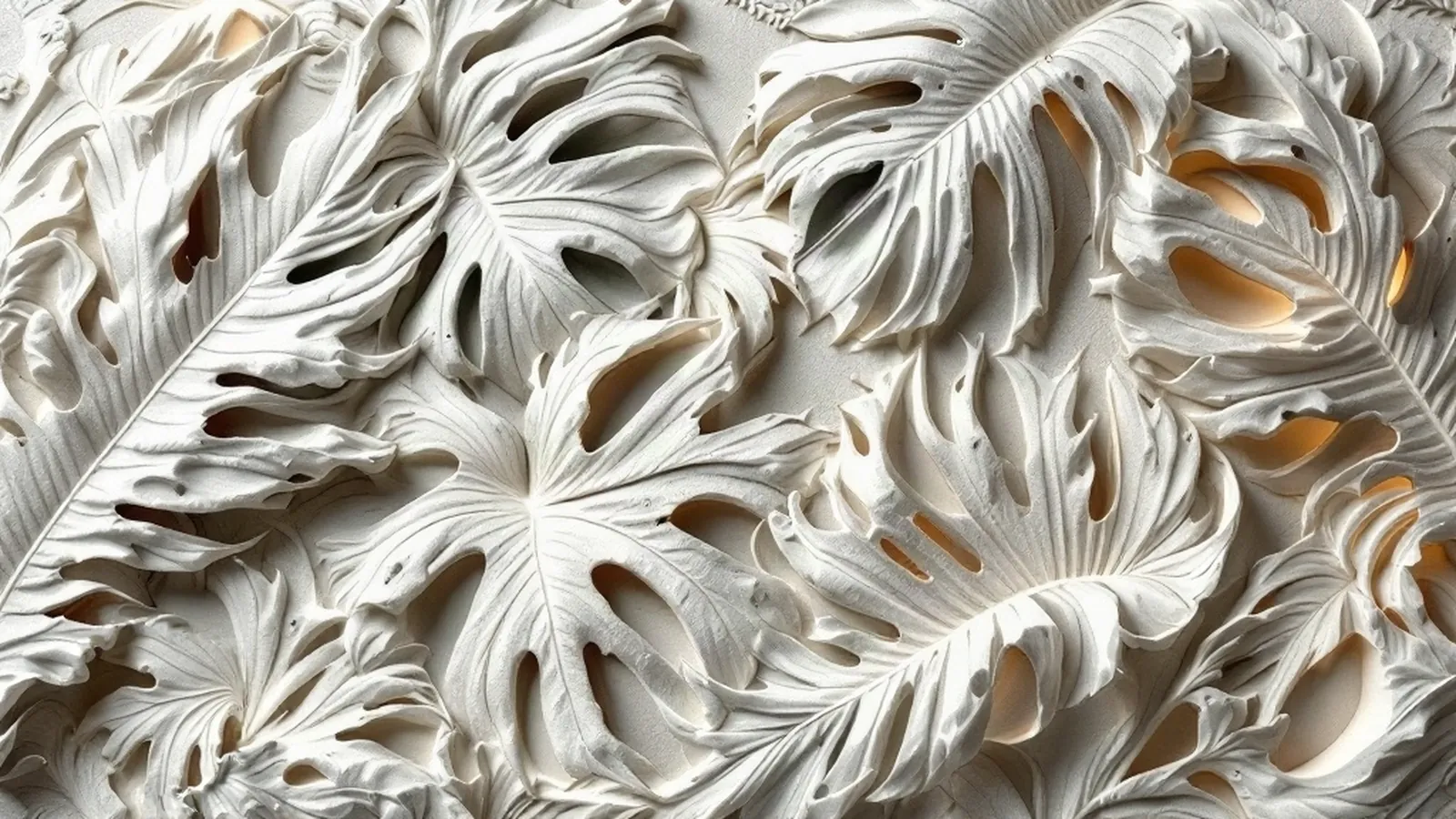
The monstera's windows suit relief: cut openings catch raking light and throw shadow. Cladeset presents it as Architectural Fenestration in High Relief, carved in plaster, where the leaf behaves like a pierced architectural screen.
Bibliographic Citations & Reference Material:
- •Madison, M. (1977). A revision of Monstera (Araceae). Contributions from the Gray Herbarium of Harvard University, 207, 3-100.