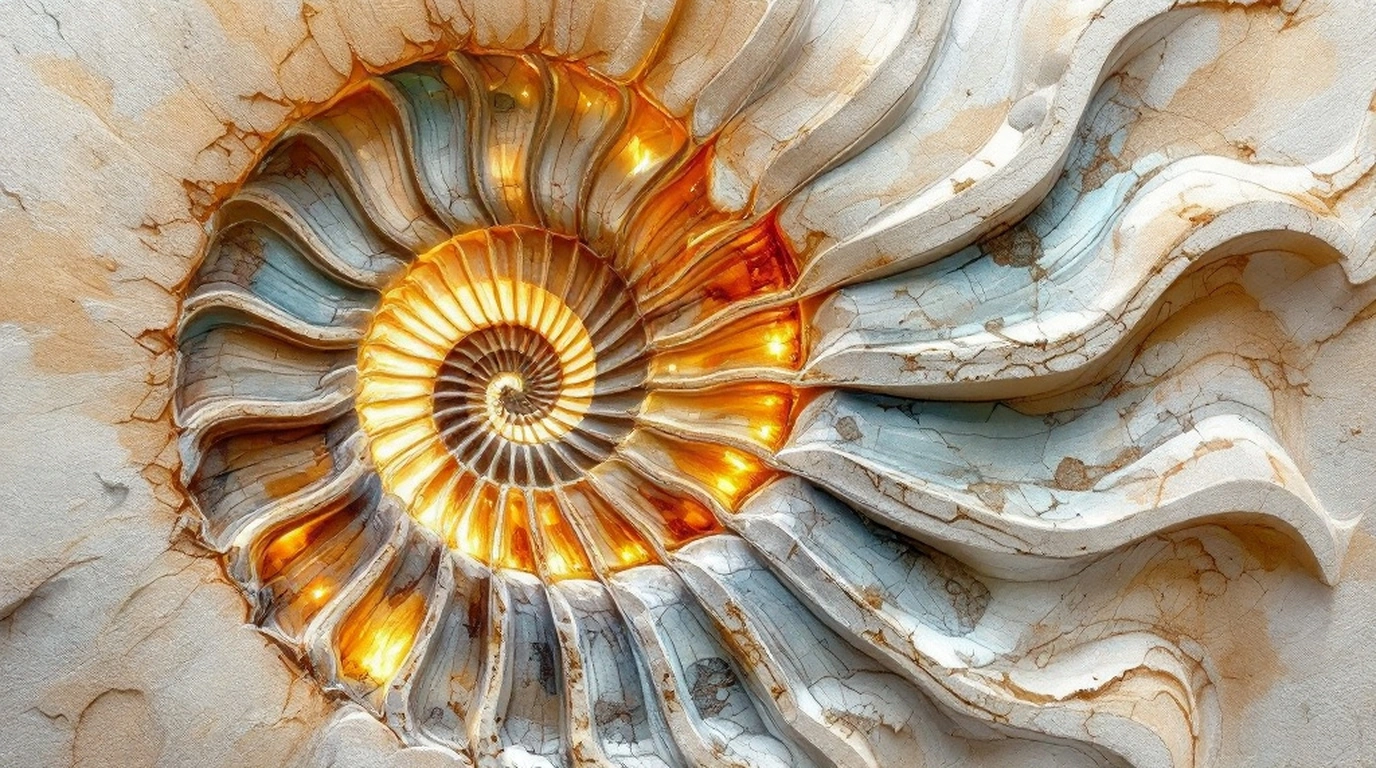
Nautilus pompilius: The Chambered Spiral
A living fossil, a collector's cup and a common mistake about the golden ratio
What is a chambered nautilus?
The chambered nautilus (Nautilus pompilius) is a cephalopod that lives in a coiled shell divided into gas-filled chambers, which it uses to control buoyancy. Its group has existed for roughly half a billion years.
The chambered nautilus is a cephalopod that lives inside a coiled shell divided into gas-filled chambers. Cut through the middle, the shell shows its own growth history as a spiral of ever larger rooms.
Historical Context & Origins
The nautiloids appear in the Late Cambrian, and the group has been in the oceans for around half a billion years, though the modern genus Nautilus is far younger. Renaissance and Baroque collectors prized polished nautilus shells, mounting them in silver gilt as drinking cups and showpieces for cabinets of curiosities. Today the animal is hunted for its shell; international trade has been regulated under CITES since 2017.
Symbolism, Myth, & Iconography
The shell stood for continuous growth and divine order in early modern Europe, and later for mathematical beauty. It is commonly said to follow the golden ratio. It does not. The shell is a logarithmic spiral, but its growth ratio per turn is not the golden ratio, and measurements of real shells vary. Hans Meinhardt's models and Peter Ward's field studies are good correctives to the popular claim.
Morphology & Aesthetic Evaluation
As the animal grows it moves forward and seals off the old chamber behind it with a new wall, the septum. A thin tube, the siphuncle, runs through every septum and lets the animal pump fluid in and out of the chambers to adjust buoyancy. In section the septa appear as curved partitions, a repeating arc whose spacing grows steadily outward.
Cladeset shows the cross-section, not the outer shell, because the section is the subject: the chambers and the siphuncle. Carved plaster suits it, with its soft raking shadows along each septum.
Bibliographic Citations & Reference Material:
- •Ward, P. D. (1987). The Natural History of Nautilus. Allen & Unwin, London.
- •Meinhardt, H. (1995). The Algorithmic Beauty of Sea Shells. Springer, Berlin.
- •Thompson, D'A. W. (1917). On Growth and Form. Cambridge University Press.