Sedimentary Strata: Time Laid in Layers
Canyon walls, rammed earth, and the principle of superposition
What are sedimentary strata?
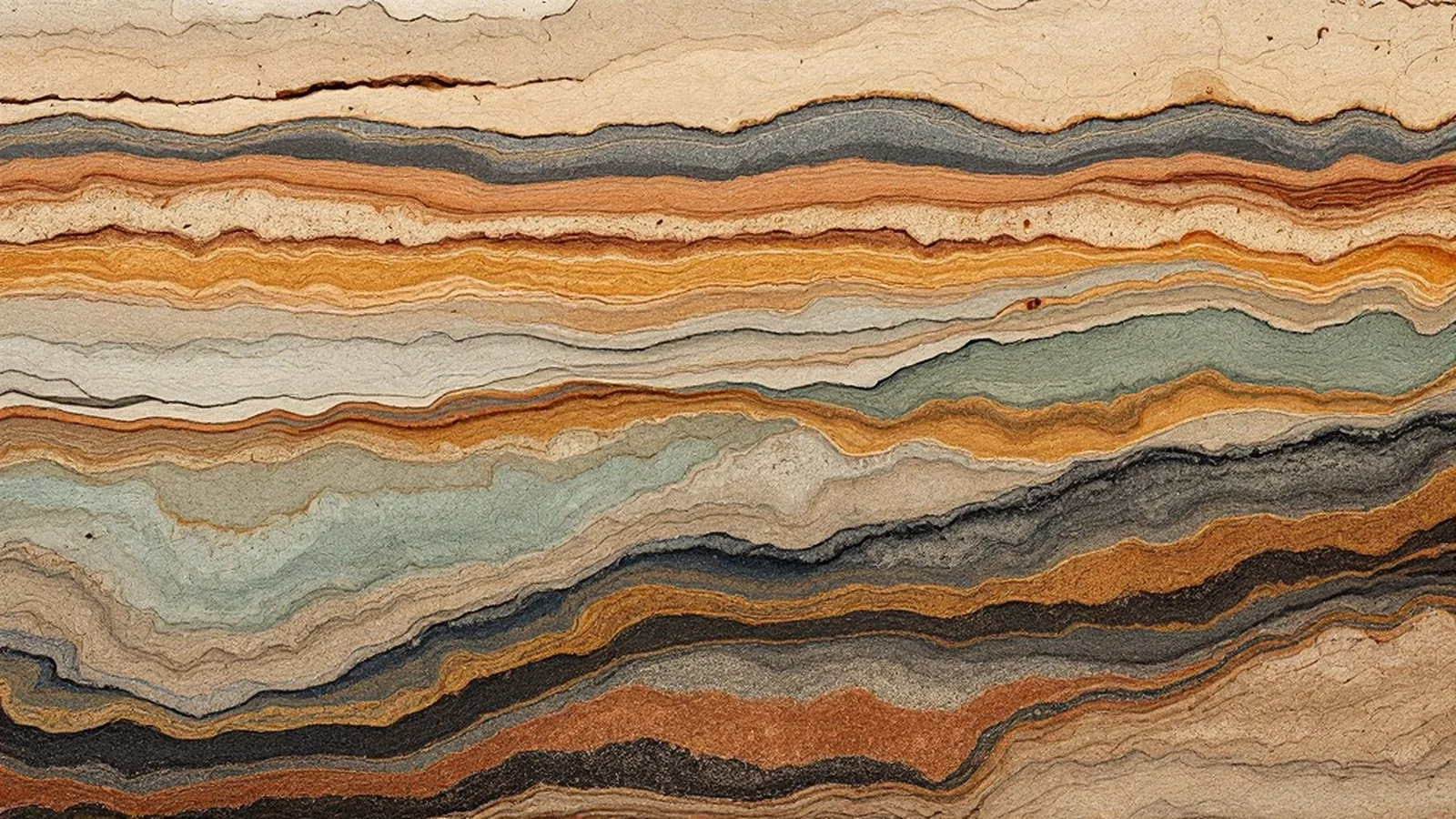
Sedimentary strata are layers of rock laid down over time, with the oldest at the bottom, a rule Nicolas Steno stated in 1669. Rammed earth walls, built in compacted layers, show the same horizontal banding.
Sedimentary rock is laid down in layers, and each layer records a period of deposition. Looking at a canyon wall is looking at time stacked from the oldest layer at the bottom to the youngest at the top.
Historical Context & Origins
Nicolas Steno stated the principle of superposition in 1669: in an undisturbed sequence, lower layers are older than those above. Earth builders use the same material logic in reverse. In rammed earth construction, damp soil is compacted in layers between formwork, and the finished wall shows the horizontal banding of its own making. The method is ancient and was used in sections of the Great Wall of China and in the walls of the Alhambra.
Symbolism, Myth, & Iconography
Strata stand for geological time and for the idea of the ground as a record. Rammed earth carries a second meaning: building from the place itself, with local soil, and with very little processing.
Morphology & Aesthetic Evaluation
The colour comes from mineral content: iron oxides give reds, oranges and yellows, and other minerals give greys and greens. Natural earth surfaces are matte, with almost no gloss, and weather unevenly so that harder bands stand proud of softer ones.
Cladeset's strata works are in plaster, terraced into stepped bands, with colour taken from mineral pigments. The matte finish suits display screens, which glare less on an unglossed surface.
Bibliographic Citations & Reference Material:
- •Easton, D. (2007). The Rammed Earth House (rev. ed.). Chelsea Green Publishing, White River Junction.
- •Rael, R. (2009). Earth Architecture. Princeton Architectural Press, New York.
- •Steno, N. (1669). De solido intra solidum naturaliter contento dissertationis prodromus. Florence.