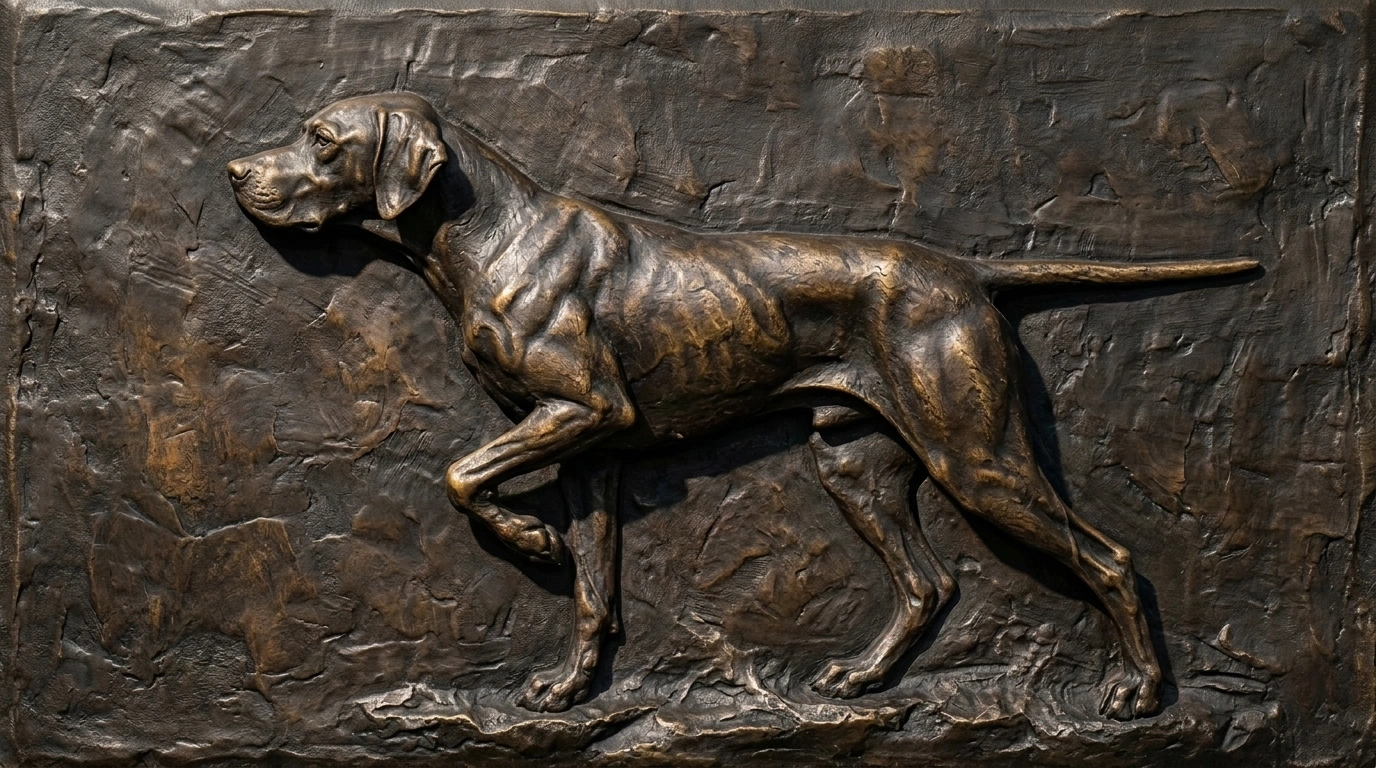
The English Pointer: Stillness Before Action
A pointing breed, the lost-wax bronze and the animaliers
What is an English Pointer?
The English Pointer is a gundog bred to find game and then freeze in a pose called the point, nose aimed at the quarry. The breed was developed in Britain from the 17th century.
The English Pointer is a gundog bred to find game and then freeze, body rigid and nose aimed at the quarry. That held pose, called the point, is the image the breed is named for.
Historical Context & Origins
Pointing dogs were developed in Britain from the seventeenth century and became specialised for wing shooting in the eighteenth. William Arkwright's book The Pointer and His Predecessors is the standard history of the breed. In nineteenth-century France, the animaliers, notably Antoine-Louis Barye and Pierre-Jules Mêne, made small and large bronzes of animals that treated sporting and wild subjects as serious sculpture.
Symbolism, Myth, & Iconography
The pointer stands for concentration, patience and the partnership between person and dog. The point is a useful image because it holds a moment of maximum tension without any movement.
Morphology & Aesthetic Evaluation
The point is a held pause in the predatory sequence: the dog orients, fixes its eyes and stalks, and in the pointing breeds the sequence is arrested at the freeze. The body shows it in a raised foreleg, a straight tail and a level back, so the whole animal becomes a taut line from nose to tail.
The Pointer: Architectural Foundry Relief shows the dog in lost-wax cast bronze, a method known as cire perdue. A wax model is coated in a ceramic shell, melted out, and the cavity filled with molten metal. The dark brown patina and the burnished brass highlights follow the foundry tradition of the animaliers.
Bibliographic Citations & Reference Material:
- •Arkwright, W. The Pointer and His Predecessors: An Illustrated History of the Pointing Dog from the Earliest Times. London.