The Black Panther: One Cat, Two Species
Melanism in leopards and jaguars, and the big cat in cast bronze
What is a black panther?
A black panther is not a species. It is a leopard (in Asia and Africa) or a jaguar (in the Americas) with melanism, an excess of dark pigment, so the coat is black with faint rosettes visible in strong light.
A black panther is not a species. It is a leopard (Panthera pardus) or a jaguar (Panthera onca) that is born dark because of melanism, an excess of dark pigment. Seen in strong light, the spots are still there, as faint rosettes under the black coat.
Historical Context & Origins
Black leopards are found across Asia and parts of Africa and are especially common in the dense forests of the Malay Peninsula. Black jaguars live in Central and South America. Cats this dark have been recorded for centuries, and they have long attracted collectors and artists. In the early twentieth century Rembrandt Bugatti modelled big cats in bronze with unusual sympathy for their movement, and the nineteenth-century animaliers had already made the large cat a subject for serious sculpture.
Symbolism, Myth, & Iconography
The panther stands for stealth, controlled power and nocturnal authority. It has been used as an emblem in heraldry, in modern design and in twentieth-century Art Deco sculpture, where its long flowing line suited the period's taste for streamlined form.
Morphology & Aesthetic Evaluation
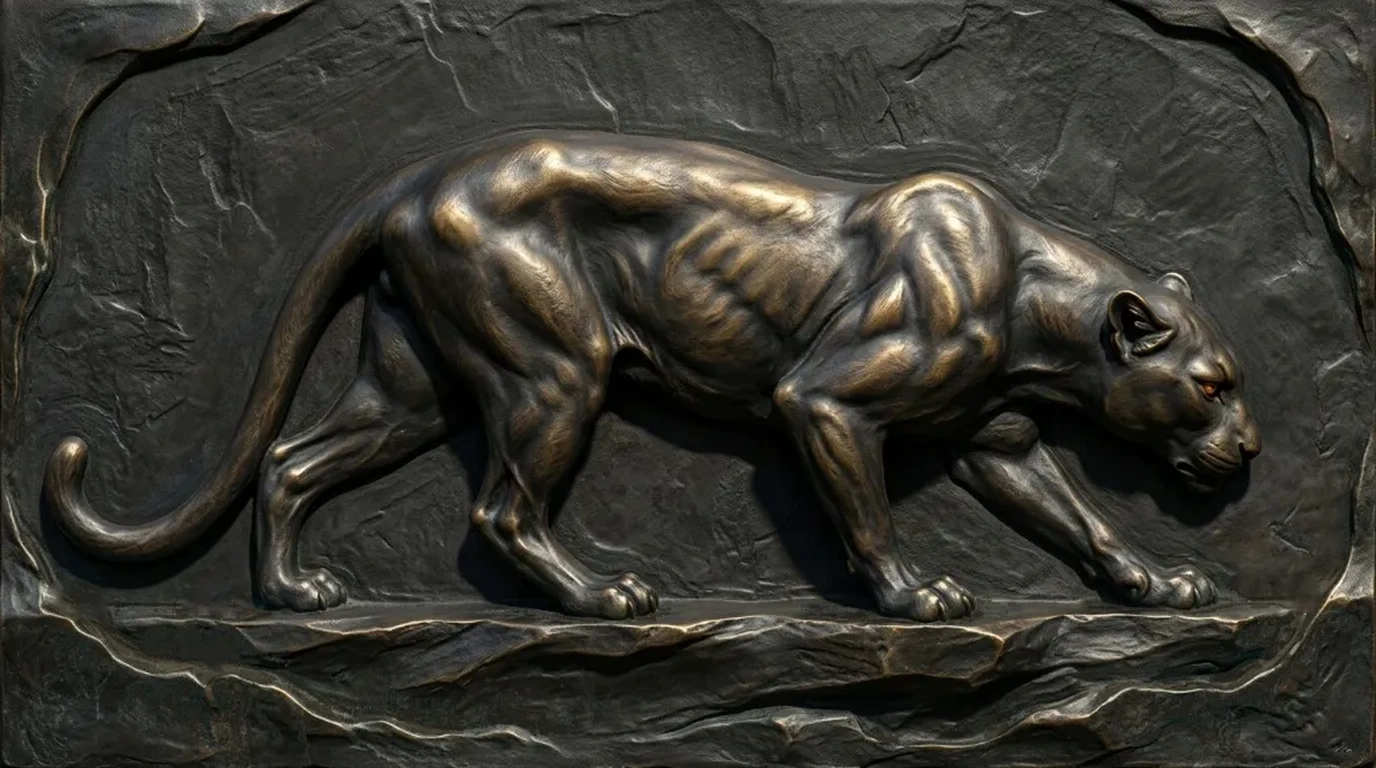
The two species reach their dark coats through different genetic routes: in the jaguar the black form is caused by a dominant variant, in the leopard by a recessive one, as described in Eizirik and colleagues' 2003 study. The result looks similar. The stalking posture is distinctive: low shoulders, the head carried level with the spine, and each foot placed deliberately. Without a rigid collarbone, a cat's shoulder blades move freely, which lets the foreleg reach far forward in a low prowl.
The Stalking Panther: Architectural Foundry Bronze Relief is shown in lost-wax cast bronze, finished with hand-burnished highlights and no artificial ageing. It belongs to the Cast Metal Relief style, with the Pointer and the Bison, where a dark form and warm metal highlights share the same raking light.
Bibliographic Citations & Reference Material:
- •Sunquist, M., & Sunquist, F. (2002). Wild Cats of the World. University of Chicago Press, Chicago.
- •Guggisberg, C. A. W. (1975). Wild Cats of the World. Taplinger Publishing, New York.
- •Eizirik, E., et al. (2003). Molecular genetics and evolution of melanism in the cat family. Current Biology, 13(5), 448-453.