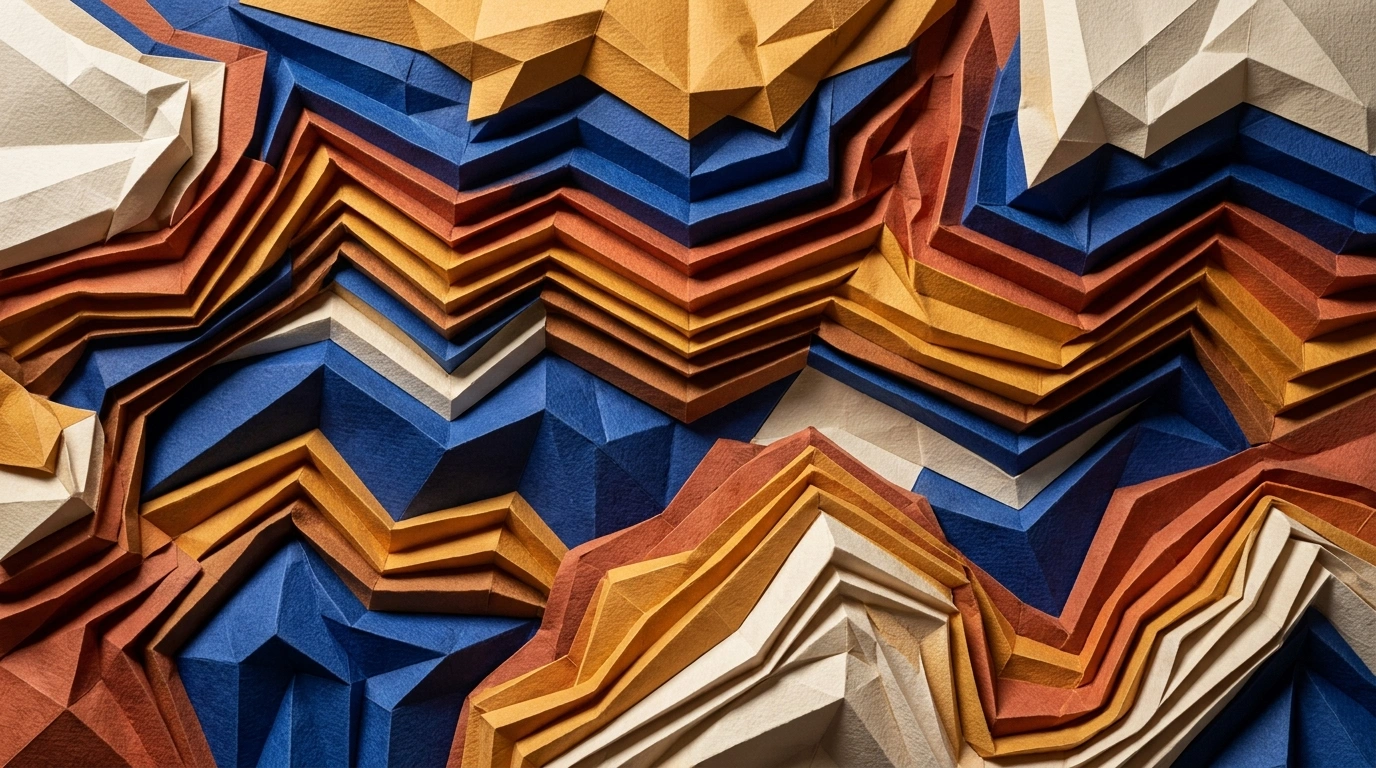
Topographic Canyon: Terraces Folded From Paper
How erosion steps a canyon wall, and how a pleated sheet can do the same
What is a topographic canyon paper relief?
It is a folded paper sculpture that models the stepped profile of a canyon wall. Pleated folds push the sheet forward in tiers, as hard and soft rock layers erode into cliffs and benches.
A canyon wall is a section through time. Rivers cut down through layered rock, and the layers erode at different rates, leaving a stepped profile of cliffs and benches. A pleated sheet of paper can reproduce that profile in miniature.
Historical Context & Origins
The stepped form of a canyon follows from the rock itself. Hard layers such as sandstone and limestone resist erosion and stand as cliffs, while softer layers such as shale wear back and form slopes or benches. Folded-plate structures use a related idea in engineering: a thin sheet gains stiffness and depth when it is pleated. Ron Resch studied folded and tessellated surfaces for sculpture and architecture in the early 1970s, and Koryo Miura's fold, from the same period, showed that a pleated sheet could pack flat and open in one motion.
Symbolism, Myth, & Iconography
The subject joins two ways of describing depth: geological time, where the lowest layers are the oldest, and mathematical order, where a repeating fold produces a surface that is both regular and complex. The shared metaphor is the section, a cut that shows how something was made.
Morphology & Aesthetic Evaluation
The work is built from pleat-corrugation folds, long parallel mountain and valley creases that step the sheet forward in horizontal terraces. Heavy cotton rag paper holds a crisp crease and accepts mineral pigment, and the fibres give a matte, slightly toothy surface. Under raking light, each mountain fold casts a shadow into the valley below it, so depth is read from the shadows more than from the colour.
Cladeset pairs this work with the origami tessellation, under the collection Architectural Paper Engineering. Where the tessellation is a repeating pattern, the canyon is a landscape: the same technique, folded paper, used to describe a place.
Bibliographic Citations & Reference Material:
- •Resch, R. D. (1973). The topological design of sculptural and architectural systems. Proceedings of the AFIPS National Computer Conference, 42, 643-650.
- •Gjerde, E. (2008). Origami Tessellations: Awe-Inspiring Geometric Designs. A K Peters, Wellesley.
- •Miura, K. (1985). Method of packaging and deployment of large membranes in space. Institute of Space and Astronautical Science Report, Tokyo.
- •Hunter, D. (1947). Papermaking: The History and Technique of an Ancient Craft (2nd ed.). Alfred A. Knopf, New York.