The Deckle Edge: Paper Torn by Hand
Cotton rag, the papermaking mould, and the feathered edge
What is a deckle edge?
A deckle edge is the soft, feathered border of handmade paper, left where the pulp thins against the edge of the mould. Tearing a thick cotton sheet by hand recreates the effect.
A deckle edge is the soft, feathered border of a sheet of handmade paper. It is formed where the pulp thins against the edge of the mould, and is the mark of paper made by hand and not cut by machine.
Historical Context & Origins
Papermaking reached Europe through the Islamic world, and by the thirteenth century mills at Fabriano in Italy were making fine paper, and developing the watermark. Early European paper was made from rags, mostly linen and cotton, which gave a durable sheet. The deckle is the removable frame fitted to the mould that holds the pulp to the right shape, and the edge it leaves is the reason the term survives.
Symbolism, Myth, & Iconography
A deckle edge signals handwork and material honesty: the edge shows how the sheet was made. When a thick sheet is torn instead of cut, the edge reveals the fibres inside, and a clean cut seems to be a statement about the opposite.
Morphology & Aesthetic Evaluation
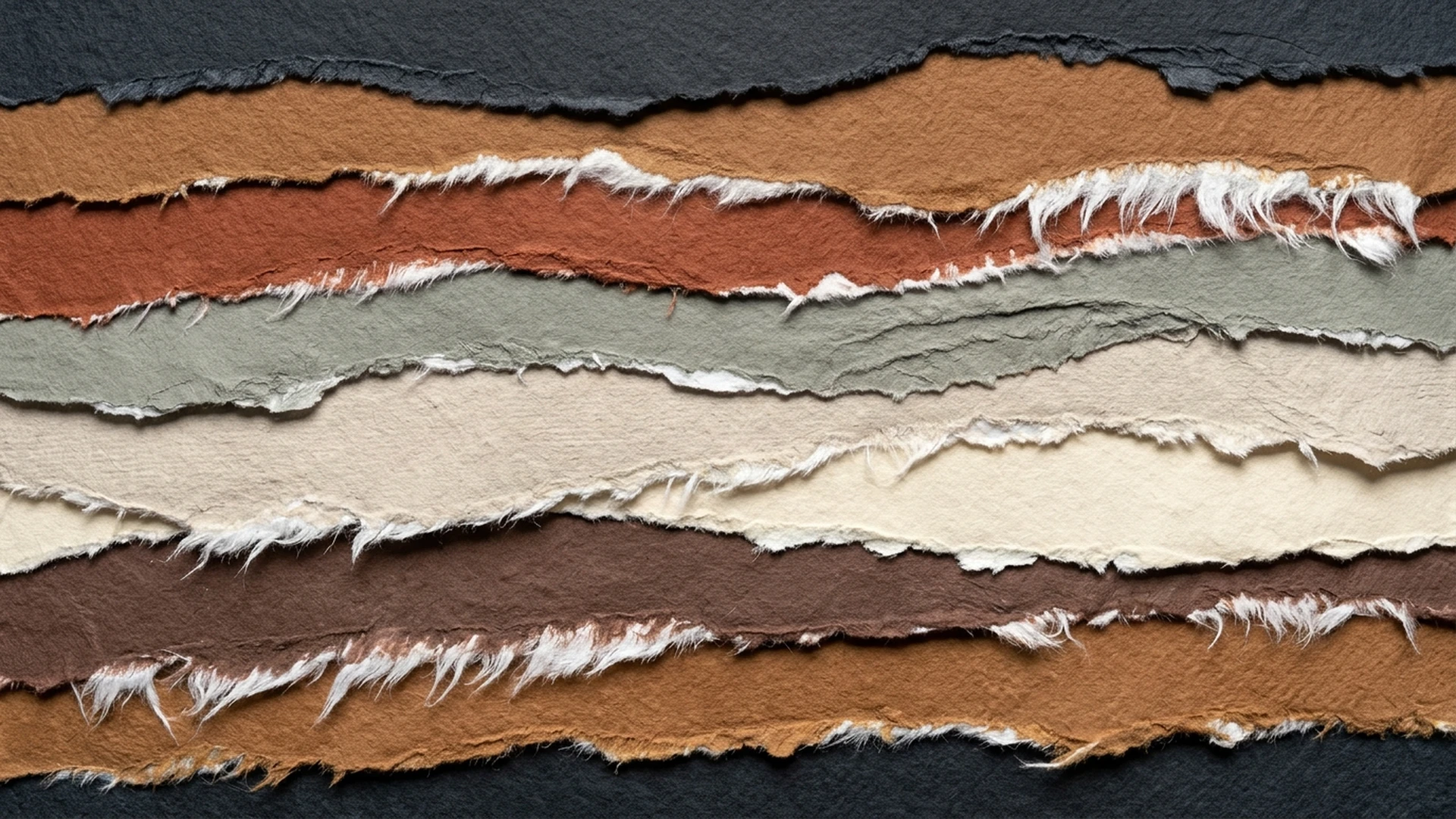
Tearing a thick cotton sheet exposes the white interior fibres in a long, feathered line, much like a dry brush stroke. Stacked in steps, torn layers cast crisp shadows from directional light, and each step becomes a shelf.
Strata of the Hand-Torn Deckle is built from stepped torn sheets, so the composition is made entirely of edges and the shadows they cast.
Bibliographic Citations & Reference Material:
- •Hunter, D. (1947). Papermaking: The History and Technique of an Ancient Craft (2nd ed.). Alfred A. Knopf, New York.
- •Barrett, T. (1983). Japanese Papermaking: Traditions, Tools, and Techniques. Weatherhill, New York.