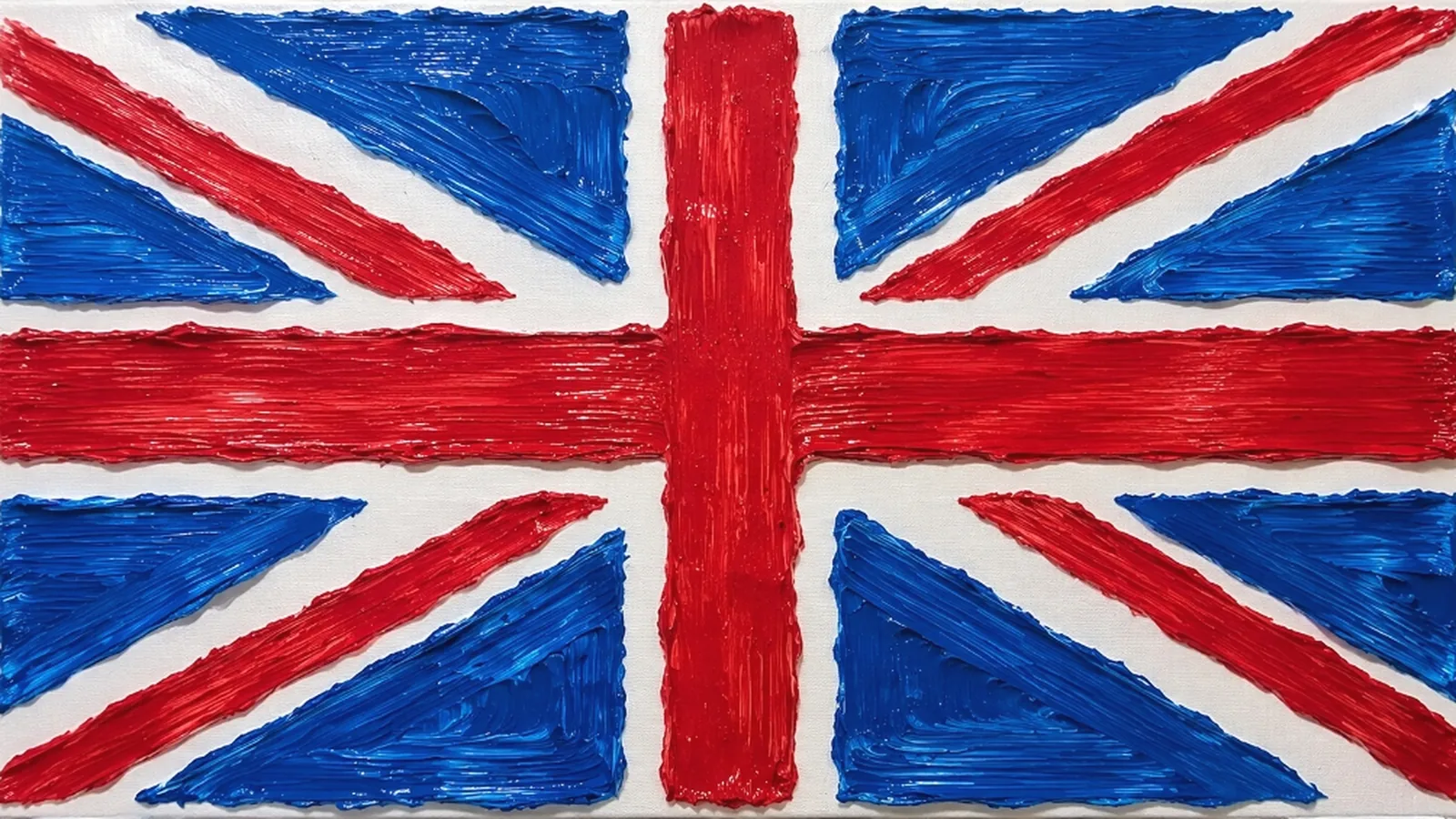
The Union Flag: Three Crosses in One
How the patron saints of England, Scotland and Ireland were layered into a single design
What is the Union Flag?
The Union Flag, or Union Jack, is the flag of the United Kingdom. It layers the crosses of St George, St Andrew and St Patrick, was first made in 1606, and took its present form in 1801.
The Union Flag, often called the Union Jack, is made of three crosses laid over each other. It is a design about combination: each of the original kingdoms is represented by the cross of its patron saint.
Historical Context & Origins
The first Union Flag was ordered by James VI of Scotland and I of England in 1606, combining the red cross of St George with the white saltire of St Andrew. When the union with Ireland took effect on 1 January 1801, the red saltire associated with St Patrick was added, giving the present design. Wales is not separately represented, because it was legally part of the Kingdom of England when the first flag was designed.
Symbolism, Myth, & Iconography
The flag's meaning is political and historical: union under one crown, with each nation's identity kept visible. In the twentieth century it also became a graphic motif well beyond the state, appearing in naval signals, 1960s pop art and fashion.
Morphology & Aesthetic Evaluation
The design looks symmetrical but is not. The red diagonals of St Patrick are offset, a heraldic device called counterchanging, so that the broader white band of St Andrew's cross sits uppermost next to the flagstaff. Flown the wrong way up, the flag is a recognised sign of distress. The three layers create a dense, overlapping geometry of diagonals against a verticals-and-horizontals cross.
Cladeset paints it in sculpted impasto oil, where the overlapping crosses become overlapping ridges of paint, each stripe sitting physically on or under the next.
Bibliographic Citations & Reference Material:
- •Groom, N. (2006). The Union Jack: The Story of the British Flag. Atlantic Books, London.
- •Smith, W. (1975). Flags Through the Ages and Across the World. McGraw-Hill, New York.