Impasto & Wax
Ready$38
The Auriverde in Heavy Impasto Oil
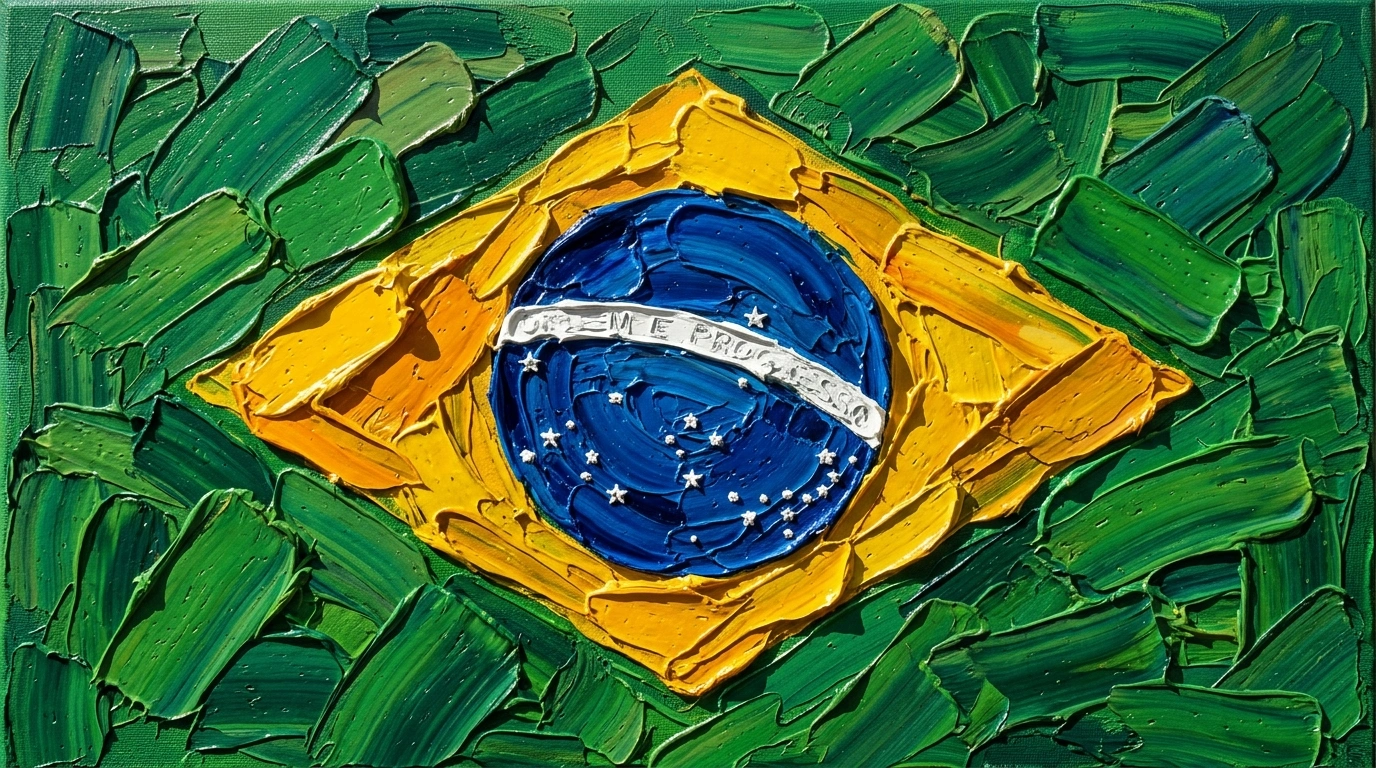
The Brazilian Auriverde sculpted in ultra-heavy oil paint impasto with broad palette-knife and trowel swathes over coarse primed linen.
The green and gold banner of Brazil, centering the celestial sphere and republican motto across an expansive starry sky.
Adopted on November 19, 1889 following the proclamation of the Republic, the Auriverde reinterpreted imperial colors into republican ideals: green for the Amazon and lush landscape, yellow for mineral wealth, and the southern sky depicting the constellation of the Southern Cross as seen from Rio de Janeiro on the night of the republic's founding.
Sovereignty, natural abundance, starry celestial navigation, and national progress.
Experience the foundational premise: select any biological or mechanical subject and observe how its visual meaning transforms across divergent artistic treatments.
Impasto & Wax rejects digital flatness. Every brushstroke preserves the kinetic momentum of wet paint, reflecting specular ceiling illumination and casting tactile perimeter shadows that fool the eye into feeling wet pigment on flat screens.
Each piece reimagines this subject through a distinct material lineage.
The Brazilian Auriverde sculpted in ultra-heavy oil paint impasto with broad palette-knife and trowel swathes over coarse primed linen.
The Brazilian flag is a green field with a large yellow rhombus, and inside it a blue disc crossed by a white band that carries the national motto, Ordem e Progresso, and 27 white stars. It is one of ...