Cladeset.wiki
TAXONOMY: FLAGS & EMBLEMS // ROOT CLADE
1 work available

Flag of Canada (The Maple Leaf)

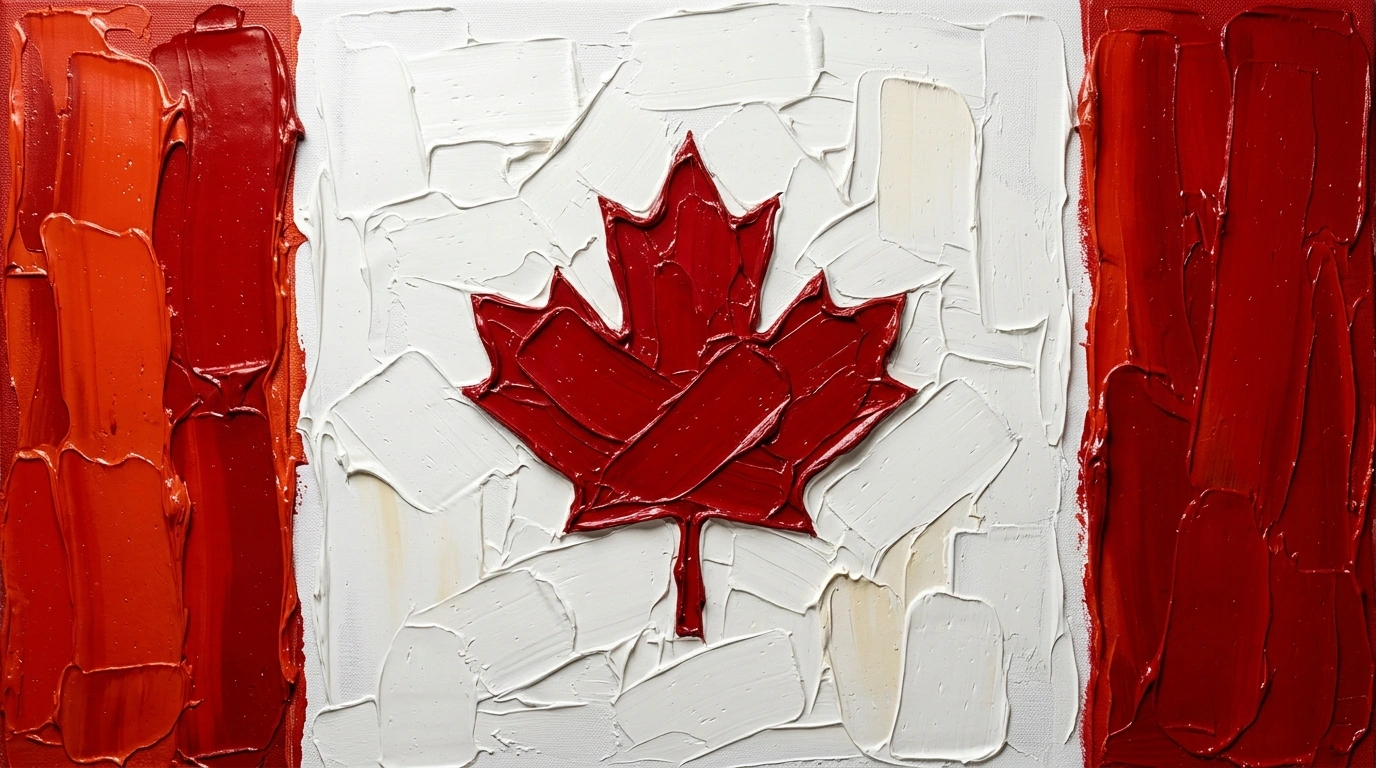
A stylized eleven-pointed crimson maple leaf centered on a white square field flanked by two bold red vertical bands.

Cultural Significance

Inaugurated on 15 February 1965 on Parliament Hill in Ottawa, the National Flag of Canada (l'Unifolié) was chosen after the historic Great Flag Debate, replacing the Canadian Red Ensign with a clean, iconic emblem of unity and natural majesty.

Core Symbolism

Sovereignty, northern wilderness, unity, peace, and national resilience.

Interactive Visual Interpretations

Compare Treatments in Real Time
INTERACTIVE TAXONOMIC MORPH

The Cladeset Engine: Subject × Medium

Experience the foundational premise: select any biological or mechanical subject and observe how its visual meaning transforms across divergent artistic treatments.

Flag of Canada digital art interpretation in fresh impasto for Samsung The Frame TV and fine art printing
SPECIMEN: FLAG-CANADA•IMPASTO & WAX

Impasto & Wax Treatment Analysis

Style Spec →

Impasto & Wax rejects digital flatness. Every brushstroke preserves the kinetic momentum of wet paint, reflecting specular ceiling illumination and casting tactile perimeter shadows that fool the eye into feeling wet pigment on flat screens.

Signature Visual Physics:
  • •Directional ridges with palpable physical depth
  • •Specular glossy highlights on stroke crests

Artwork of Flag of Canada

Each piece reimagines this subject through a distinct material lineage.

Encyclopedia Entry Available

L'Unifolié: The Maple Leaf Flag

Canada's flag is a red field with a white square in the centre, carrying a stylised red maple leaf of eleven points. It is one of the simplest national flags in use....

Read Complete Monograph →

Curatorial & Scientific Notes

  • 01.Designed by George Stanley based on the flag of the Royal Military College of Canada.
  • 02.The maple leaf has been an emblem of French Canadians since the 1700s and of Canada as a whole since the mid-19th century.
  • 03.In heavy impasto painting, the minimalist geometry allows the viscous palette-knife ridges and linen tooth to create profound sculptural presence.